Core Concepts
Understanding the building blocks of Zeotap and how they fit together.
The Data Flow
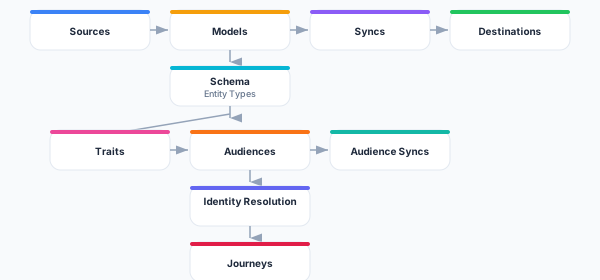
Zeotap follows a warehouse-first architecture where your data warehouse is the single source of truth. Data flows through the platform in a clear pipeline:
Key Concepts
Warehouses
A source is a connection to your data warehouse. Zeotap reads data from sources but never writes to them (except for materialized models). Supported warehouses include Snowflake, BigQuery, Databricks, and ClickHouse.
Models
A model is a SQL query that defines a view of your data. Models shape raw warehouse tables into the format you need for syncing. Each model is tied to a source and produces a result set with typed columns.
Relationships & Entity Types
The Relationships module defines the structure of your customer data. Entity types (like “User”, “Account”, “Product”) represent the core objects in your data model. Relationships connect entity types to each other (e.g., a User belongs to an Account).
Destinations
A destination is an external tool where you send data. Zeotap supports 50+ destinations across CRM, advertising, marketing, analytics, warehouses, cloud storage, and streaming categories.
Reverse ETL
A Reverse ETL sync connects a model to a destination. It defines the field mapping, sync mode (upsert, mirror, append), and schedule. Sync runs track each execution with row counts and error details.
Computed Attributes
A computed attribute is a derived metric about a customer entity. Computed attributes can be SQL-based (custom queries), aggregation-based (count, sum, average), or formula-based (combine other computed attributes). Computed attributes are evaluated on a schedule and stored for audience building.
Audiences
An audience is a segment of customers defined by conditions on computed attributes and entity attributes. The visual filter builder lets you combine conditions with AND/OR logic. Audiences support size estimation and preview before activation.
Syncs (Activation)
A sync sends an audience to a destination. Unlike Reverse ETL syncs that map model columns, audience syncs manage membership lists with modes like mirror (full sync), additive (only add), and subtractive (only remove).
Identity Resolution
Identity resolution unifies customer records across data sources using a connected-components graph algorithm. You define identifier families (email, phone, device ID), merge rules, and limit rules. The output is a set of golden records — unified customer profiles.
Orchestrations
An orchestration is a multi-step, multi-channel workflow that customers move through based on triggers and conditions. Orchestrations use a visual canvas editor with tiles for entry, wait, branch, action, and exit.
Events
The events module handles real-time event collection (Segment-compatible API), schema enforcement via contracts, transformations, and forwarding to downstream tools.
Loaders
Loaders pull data from SaaS applications (Salesforce, HubSpot, Stripe, etc.) into your data warehouse on a schedule, acting as ETL connectors.
Governance
Governance controls who can access what and how data flows. This includes RBAC (roles, permissions, groups), destination policies (which audiences can sync where), and access policies (row-level access control).
Insights
Insights provide operational dashboards for sync health, audience trends, activation coverage (how much of your audience is being reached), and audience overlap analysis.
Zeotap Agent
Zeotap’s AI platform includes a natural language audience builder (describe an audience in plain English), an AI agent that can perform complex multi-step operations, and an MCP server for external AI tool integration.